
Building an AI-Operated EV Intelligence Platform for Canada
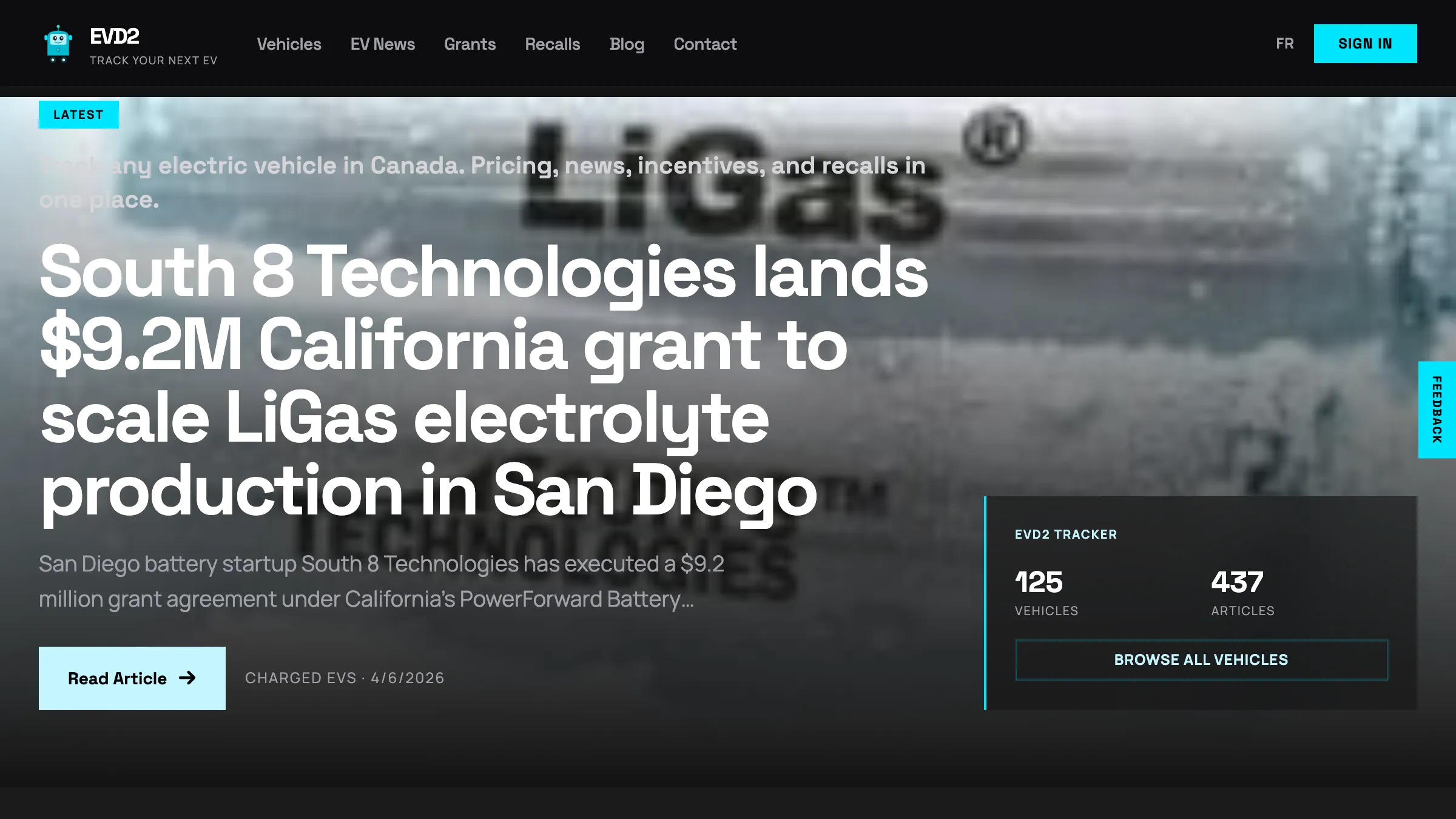
It started the way a lot of my projects do: a rabbit hole.
A few ChatGPT conversations about EV range anxiety. Some late-night browsing on automotive sites. Then Autotrader, pulling up used EV listings to see how they held their value compared to gas vehicles. I wanted to understand the Canadian market, and I quickly realized the information was everywhere and nowhere at the same time. Scattered across news sites, OEM pages, government rebate tables, and forum threads. No single place that just told me: here's what's happening with this vehicle, right now, in Canada.
So I built it.
EVD2.ca tracks Canada's EV market the way a stock trader watches a portfolio. Not "here's what happened." But "here's what changed, right now, about the specific vehicle you care about."
That's a fundamentally different product.
Most Canadian EV information is scattered across news sites, manufacturer pages, and government rebate tables, with no single source tracking what actually changes about a specific vehicle. EVD2.ca is an AI-operated intelligence platform that monitors Canada's EV market in real time, treating each vehicle as a living entity rather than a content topic. This post covers the system architecture, the hard lessons from building it, and why the most important insight has nothing to do with electric vehicles.
The Idea: Follow the Vehicle, Not the News
The insight that drove everything: the vehicle should be the primary object, not the article.
Every other EV site asks "What's the latest news?" We ask "What has changed about the Tesla Model Y in Canada today?"
That one shift rewires the whole architecture. Each EV becomes a living entity with a pulse: new media coverage, spec updates from OEM sites, government rebate changes, availability signals, pricing movement. The site doesn't publish. It watches.
The System Behind It
Three layers make this work.
Ingestion (What's happening?) The platform continuously monitors Canadian EV news sources, OEM vehicle pages, and Government of Canada incentive listings. Every update, every change, every signal gets captured.
Interpretation (What does it mean?) AI processes those signals to summarize articles, extract vehicle references, collapse duplicate stories, and flag confidence levels. The goal isn't to replace the source. It's to make the signal navigable.
Delivery (Who cares?) Users don't subscribe to a feed. They subscribe to a vehicle. Or a market segment. Then they get a digest or an alert the moment something they actually care about changes. Less media site, more intelligence briefing.
What We Learned Building a "Mostly AI" Website
Six months in, here's what surprised us.
The AI part was the easy part. Ingestion was the war. Finding reliable sources, normalizing wildly inconsistent formats, handling partial data, respecting content ownership. Get the pipeline wrong and it doesn't matter how good your model is. Garbage in, garbage out, at scale.
Deduplication separates products from noise. Canadian media is heavily consolidated. The same story hits five outlets within minutes with slightly different headlines. Without aggressive deduplication, you're just amplifying the echo chamber. We had to stop thinking like publishers and start thinking like signal processors.
Entity matching will humble you. "Model Y," "Tesla crossover," "2025 refresh." Same vehicle. Maybe. This is exactly where AI earns its keep, and exactly where it goes sideways without guardrails. Getting entity resolution right is an ongoing project, not a checkbox.
AI organizes. The source stays king. We made a hard call early: AI generates summaries, labels confidence, helps organize. But every summary links back to the original source. Users always have a path to the truth. Synthetic "news" that sounds authoritative but isn't grounded is a product-killing trap.
Email beats everything. The most valuable thing we built isn't the website. It's the alert: "Something changed about the EV you're following." That's pure utility. No SEO play, no content strategy. Just a signal people actually want.
Structure first, always. We didn't write a line of code until we had a full PRD, a data model, ingestion pipeline specs, and AI processing definitions. With AI systems, a structural mistake doesn't slow you down. It accelerates you in the wrong direction.
This Is Also a GEO Experiment
There's a second game being played here. Generative Engine Optimization.
ChatGPT, Perplexity, and their peers don't browse like users. They extract structured signals and synthesize answers. So EVD2.ca is built to be machine-readable from the ground up: clean entity pages, structured summaries, high semantic precision. We're not just optimizing for Google rankings. We're optimizing to be the source AI systems trust.
Where This Goes Next
The MVP is live: RSS ingestion, EV profile pages, email subscriptions, AI summaries. The roadmap gets more interesting from here. Deeper OEM scraping. Government dataset integration. Better entity resolution. Eventually, real inventory and availability signals.
Final Thought
The most provocative thing about this project has nothing to do with electric vehicles.
We're watching a shift happen in real time: from websites that publish content to systems that monitor reality and surface change. AI isn't a feature you bolt onto a media product. It's a different kind of product entirely.
If you're building something in this space, or rethinking what AI as an operating model actually looks like in practice, I'd genuinely love to compare notes.
Frequently Asked Questions
What is EVD2.ca?
EVD2.ca is a Canadian EV intelligence platform that tracks changes to specific electric vehicles in real time, including pricing, government incentives, OEM spec updates, and media coverage. Rather than publishing general EV news, it monitors each vehicle as a distinct entity and alerts subscribers when something relevant to their vehicle of interest changes.
How is EVD2.ca different from other EV news sites?
Most EV sites are organized around articles. EVD2.ca is organized around vehicles. The primary object is the car, not the content. Instead of browsing a news feed, users follow specific models and receive targeted alerts when something changes about that vehicle in the Canadian market.
What EVs does EVD2.ca track?
EVD2.ca focuses on electric vehicles available in the Canadian market, including models eligible for federal and provincial incentive programs. Coverage includes mainstream EVs from major OEMs as well as emerging models entering the Canadian market.
Does EVD2.ca track government rebates and incentives?
Yes. Government of Canada EV listings and incentive programs are monitored as part of the ingestion pipeline. Changes to rebate eligibility or amounts are treated as signals tied to the affected vehicle profiles.
How does the AI summarization work?
The platform uses AI to process incoming signals, summarize articles, extract vehicle references, cluster duplicate stories from different outlets, and assign confidence levels to extracted data. The original source is always preserved and linked. AI organizes the signal; the source remains the authority.
Can I subscribe to alerts for a specific vehicle?
Yes. Users can follow specific EVs or broader market segments and receive daily or weekly digests, as well as alerts when something meaningful changes about a vehicle they follow.
How does EVD2.ca handle duplicate stories from Canadian media?
Canadian media is heavily consolidated, and the same story often appears across multiple outlets within minutes. EVD2.ca uses deduplication logic to collapse these into a single signal rather than surfacing the same story multiple times under different headlines.
What is Generative Engine Optimization (GEO) and why does it matter here?
GEO is the practice of structuring web content so AI systems like ChatGPT and Perplexity can accurately extract, cite, and surface it in AI-generated answers. EVD2.ca is built with GEO principles from the ground up, using clean entity pages, structured summaries, and high semantic clarity so the platform becomes a trusted source for AI-generated responses about Canadian EVs.

Colin Smillie
Most recently VP Technology at YMCA Canada. Building and shipping real products with AI-assisted development. More about Colin's advisory and executive work at colinsmillie.com.