
Fresh News: An AI-Built Aggregator for Canadian News
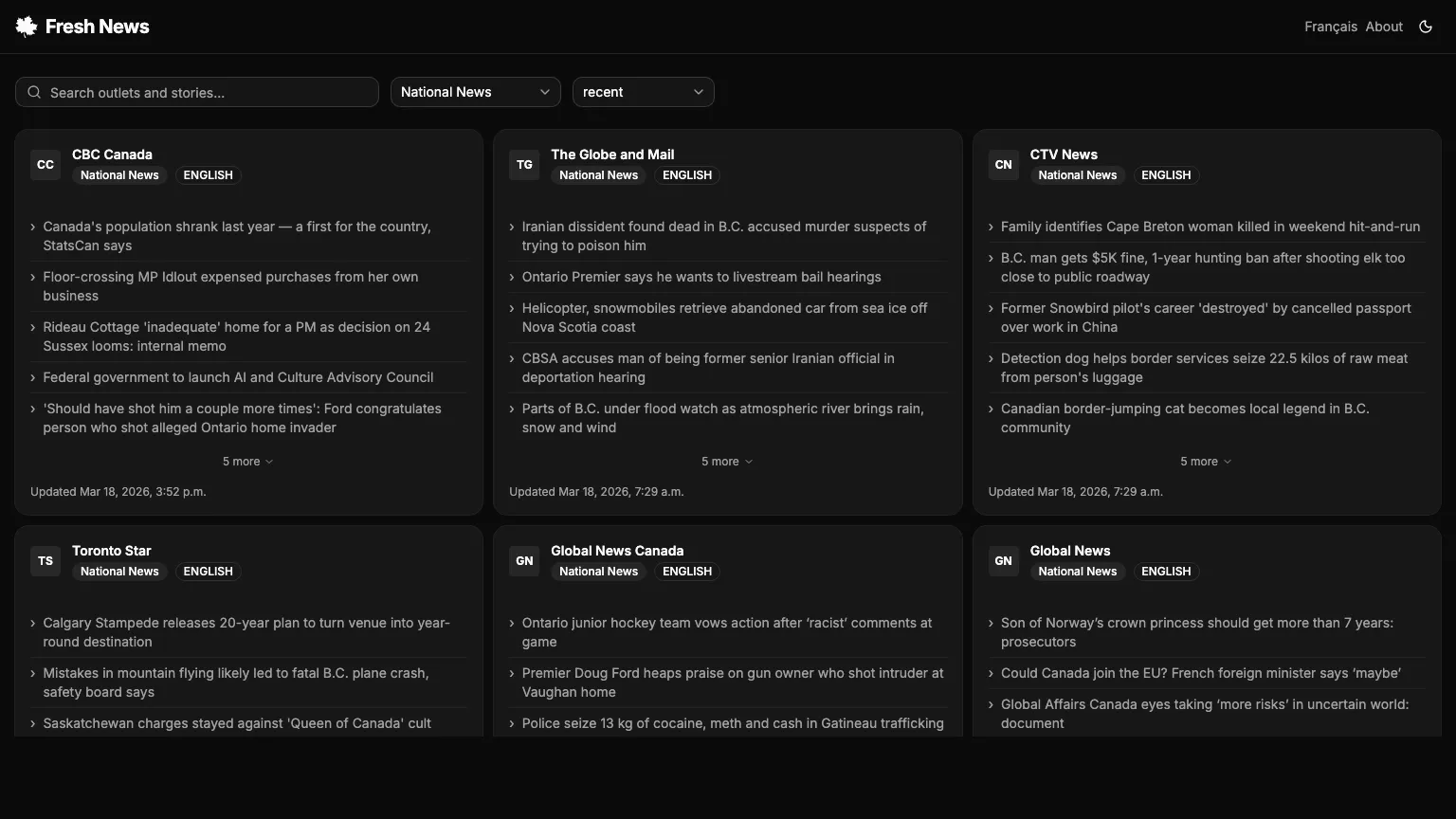
Fresh News is a Canadian news aggregator that pulls headlines from 75+ media outlets in English and French, linking directly to the original publisher without ever republishing content. Built with Next.js and Claude Code, it deliberately avoids AI summaries and editorial ranking. This post covers the rebuild from WordPress, the AI development process, and why the hardest decisions had nothing to do with code.
How it started
Fresh News goes back years. The original version was a PHP project I built with Roy Pereira, inspired by FreshNews.org. My initial concept was a straightforward Canadian copy of that site, but Roy pushed it in a better direction. He suggested leaning hard into the Canadian news angle specifically, making it a tool for finding and consuming Canadian media in one place. That reframing gave the project its identity.
After the PHP version, I ran Fresh News on a WordPress theme for several years. It worked, but it always felt like I was fighting the platform to get the experience I wanted. When I started exploring AI-assisted development, I decided to rebuild from scratch. The new version was one of my first projects using Next.js, and I developed it entirely with Claude Code. No WordPress, no templates, just a clean codebase I actually understood and could iterate on.
It's become a site I genuinely use every day to stay on top of what's happening across the country.
What I built
Fresh News pulls headlines from over 75 Canadian media outlets. English and French. It organizes them by topic (politics, business, tech, environment, sports, and more) and links directly to the original publisher. Every link takes you straight to the source. Fresh News never copies article content, never republishes text, and never attempts to bypass paywalls. If an outlet has a paywall, you see the headline and you hit the paywall when you click through. That's by design.
I think it's important to support Canadian media. The industry is under real pressure, and the last thing it needs is another platform scraping content and keeping readers from the publishers who did the actual reporting. Fresh News is a discovery tool, not a replacement for reading the real thing.
The stack is Next.js with server-side rendering, deployed on Vercel. The RSS parsing runs on a schedule, normalizing feeds from outlets that all structure their data differently.
The AI process
This was actually my first real Next.js project, so Claude Code was pulling double duty: teaching me the framework while helping me build the product. The RSS normalization was where AI saved the most time.
Every news outlet structures their RSS feed slightly differently. Some use content:encoded, some use description, some put the full article in the feed, some put a sentence. Date formats vary. Categories vary. Character encoding varies. It's the kind of work where you're writing the same pattern fifty times with minor tweaks for each source.
Claude Code was perfect for this. I'd set up the pattern for one outlet, then say "now do the same for these ten, here are their feed URLs and here's how their XML differs." Grunt work that would have taken days compressed into hours.
Where it got more interesting was the topic classification. I wanted articles tagged by topic without relying on each outlet's own categories (which are wildly inconsistent). Claude Code helped me build a keyword-based classifier that's simple but effective. Not ML, just smart pattern matching against a curated list of topic indicators.
Where experience beat AI suggestions
Claude Code kept suggesting I add AI-powered features. Summarize articles with GPT. Rank stories by importance. Generate briefings. Every suggestion was technically sound and would have been wrong for this product.
The whole point of Fresh News is that it doesn't editorialize. The moment you add AI summaries, you're a publisher, not an aggregator. The moment you rank stories, you're making editorial decisions. I wanted the opposite: give people the raw firehose, organized clearly, and let them decide what matters.
This is where experience matters. A less experienced builder might have chased the shiny AI features because they're impressive. But I've watched enough products fail by adding complexity that serves the builder's interests over the user's. Fresh News works because it does one thing and does it cleanly.
Playing fair with publishers
Fresh News respects every outlet's robots.txt rules. If a publisher's robots.txt says don't crawl, we don't crawl. If any media site requests removal, they get removed. No questions, no pushback. The goal is to send readers to publishers, not to take anything from them.
This isn't just a policy, it's the whole point. Canadian journalism is worth supporting. If Fresh News can help someone discover a regional outlet they wouldn't have found otherwise and that outlet gets a reader out of it, that's the best possible outcome.
The editorial problem
The hardest part wasn't technical at all. It was deciding which outlets to include. You can't build a news aggregator without making editorial choices about source quality. Include everything and you dilute trust. Curate too aggressively and you become the gatekeeper you're trying to avoid.
I landed on a simple heuristic: established outlets with professional editorial standards. No blogs, no opinion-only sites, no outlets that have been flagged by media watchdogs. It's not perfect, and I revisit the list regularly, but it gave me a defensible starting point.
What I learned
Building Fresh News reinforced something I keep coming back to: AI is phenomenal at the known patterns and terrible at the judgment calls. The RSS parsing was a known pattern. The topic classification was a known pattern. But "should this source be included?" and "should we add AI summaries?" were judgment calls that required understanding the product's reason for existing.
The gap between what AI can build and what you should build is where product experience lives. And that gap isn't getting smaller. If anything, as AI makes more things possible, the "should we?" question becomes more important, not less.
What's next
Fresh News is live at freshnews.ca and I'm actively expanding the source list. The big opportunity is broader categories and more languages. Canada has vibrant media communities publishing in Mandarin, Punjabi, Arabic, and more, and right now Fresh News doesn't surface any of that. Fixing that feels like the right next step. I'd also like to add more niche categories beyond the current topic set to better reflect the range of what Canadian outlets actually cover.
Frequently Asked Questions
What is Fresh News?
Fresh News is a Canadian news aggregator that pulls headlines from over 75 media outlets in English and French, organized by topic. It links directly to the original publisher and never republishes article content. It was built with Next.js and Claude Code.
Does Fresh News copy or republish articles?
No. Fresh News links directly to the original publisher for every headline. It never copies article content, never republishes text, and never attempts to bypass paywalls. If a publisher has a paywall, readers hit it when they click through. The goal is to send readers to publishers, not take anything from them.
How many Canadian news sources does Fresh News track?
Fresh News pulls headlines from over 75 Canadian media outlets, covering English and French language publications across topics including politics, business, technology, environment, and sports.
How does Fresh News decide which outlets to include?
Fresh News includes established outlets with professional editorial standards. No blogs, no opinion-only sites, and no outlets flagged by media watchdogs. The source list is reviewed regularly. Any publisher can request removal and will be removed without question.
Does Fresh News use AI to summarize or rank articles?
No. Fresh News deliberately avoids AI summaries and AI-powered story ranking. Adding summaries would make it a publisher rather than an aggregator, and ranking stories would mean making editorial decisions. The site presents the raw feed organized by topic and lets readers decide what matters.
Does Fresh News respect robots.txt?
Yes. Fresh News respects every outlet's robots.txt rules. If a publisher's robots.txt says don't crawl, Fresh News doesn't crawl. Publishers can also request removal at any time.

Colin Smillie
Most recently VP Technology at YMCA Canada. Building and shipping real products with AI-assisted development. More about Colin's advisory and executive work at colinsmillie.com.